

Free paper practice
NEET 2018 – PYQ Practice
NEET UG (National Eligibility cum Entrance Test) • 2018 • 156 Questions • Free practice
Q1Physics
The magnetic potential energy stored in a
certain inductor is 25 mJ, when the current
in the inductor is 60 mA. This inductor is of
inductance
A. 0.138 H
B. 138.88 H
C. 1.389 H
D. 13.89 H
View answer and available explanation
Correct Option: D
Answer D follows the ExamSIDE indexed key. See the credited source; not independently verified against an official final key.
Q2Physics
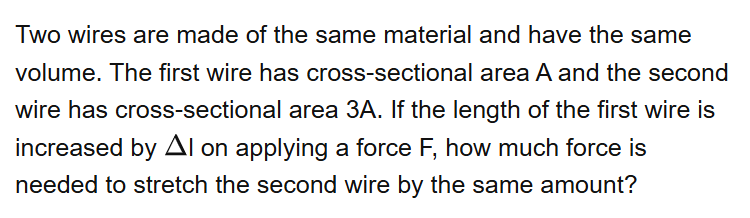
A. 6F
B. F
C. 9F
D. 4F
View answer and available explanation
Correct Option: C
Answer C follows the ExamSIDE indexed key. See the credited source; not independently verified against an official final key.
Q3Physics
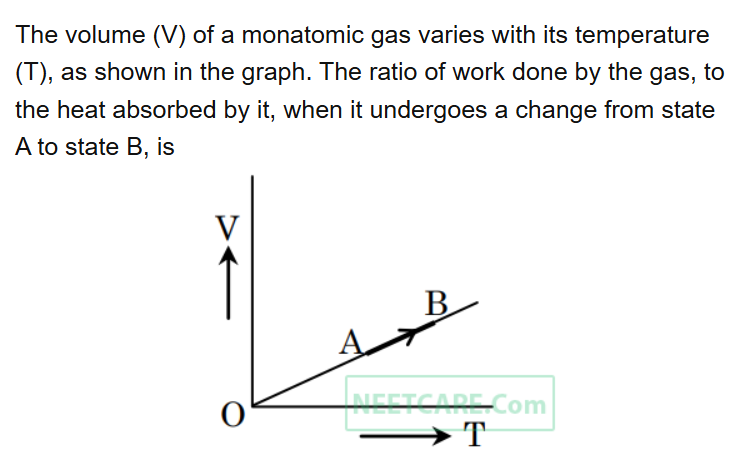
A. 
B. 
C. 
D. 
View answer and available explanation
Correct Option: A
Answer A follows the ExamSIDE indexed key. See the credited source; not independently verified against an official final key.
Q4Physics
If the mass of the Sun were ten times smaller
and the universal gravitational constant were
ten times larger in magnitude, which of the
following is not correct?
A. Raindrops will fall faster.
B. Walking on the ground would become more
difficult.
C. Time period of a simple pendulum on the
Earth would decrease.
D. g on the Earth will not change.
View answer and available explanation
Correct Option: D
Answer D follows the ExamSIDE indexed key. See the credited source; not independently verified against an official final key.
Q5Physics
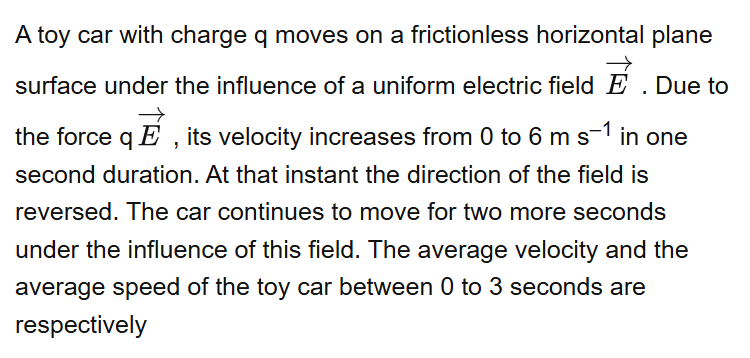
A. 
B. 
C. 
D. 
View answer and available explanation
Correct Option: B
Answer B follows the ExamSIDE indexed key. See the credited source; not independently verified against an official final key.
Q6Physics
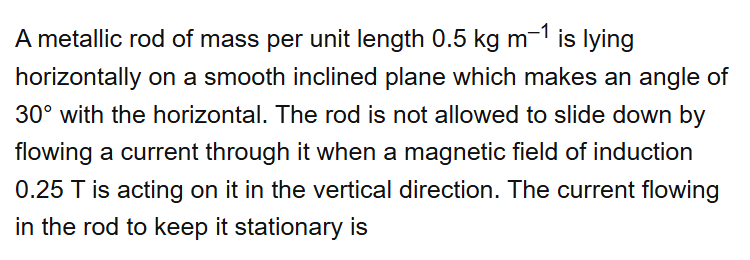
A. 7.14 A
B. 5.98 A
C. 14.76 A
D. 11.32 A
View answer and available explanation
Correct Option: D
Answer D follows the ExamSIDE indexed key. See the credited source; not independently verified against an official final key.
Q7Physics
An electron falls from rest through a vertical
distance h in a uniform and vertically upward
directed electric field E. The direction of electric
field is now reversed, keeping its magnitude the
same. A proton is allowed to fall from rest in it
through the same vertical distance h. The time
of fall of the electron, in comparison to the time
of fall of the proton is
A. smaller
B. 5 times greater
C. 10 times greater
D. equal
View answer and available explanation
Correct Option: A
Answer A follows the ExamSIDE indexed key. See the credited source; not independently verified against an official final key.
Q8Physics

A. Violet – Yellow – Orange – Silver
B. Yellow – Violet – Orange – Silver
C. Yellow – Green – Violet – Gold
D. Green – Orange – Violet – Gold
View answer and available explanation
Correct Option: B
Answer B follows the ExamSIDE indexed key. See the credited source; not independently verified against an official final key.
Q9Physics
A battery consists of a variable number n of
identical cells (having internal resistance r each)
which are connected in series. The terminals
of the battery are short-circuited and the current
I is measured. Which of the graphs shows the
correct relationship between I and n?
A. 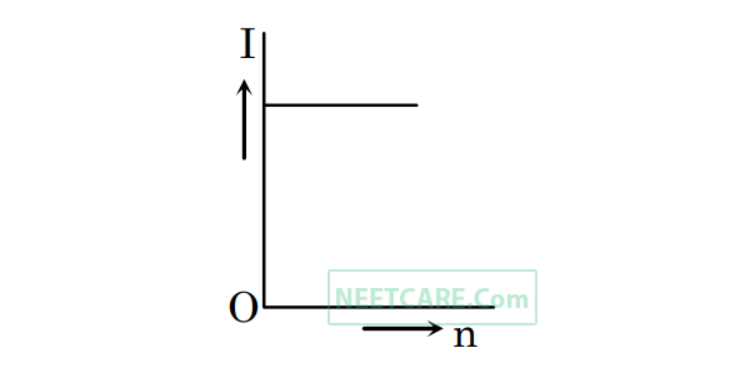
B. 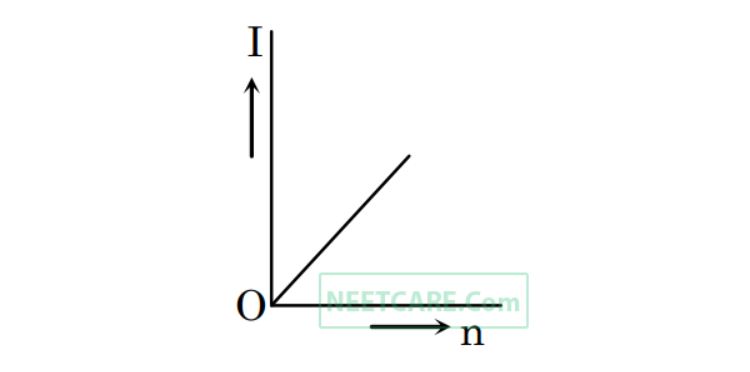
C. 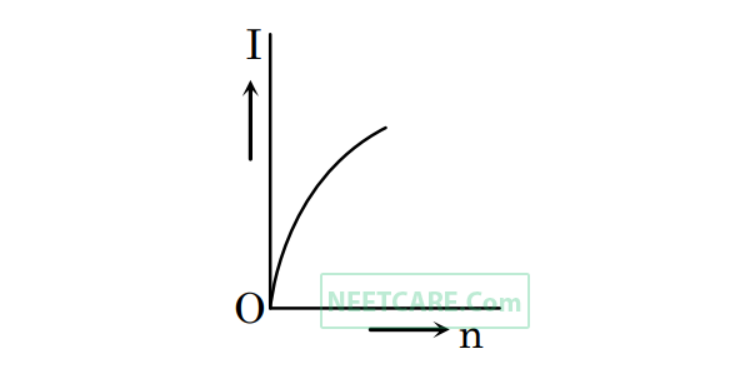
D. 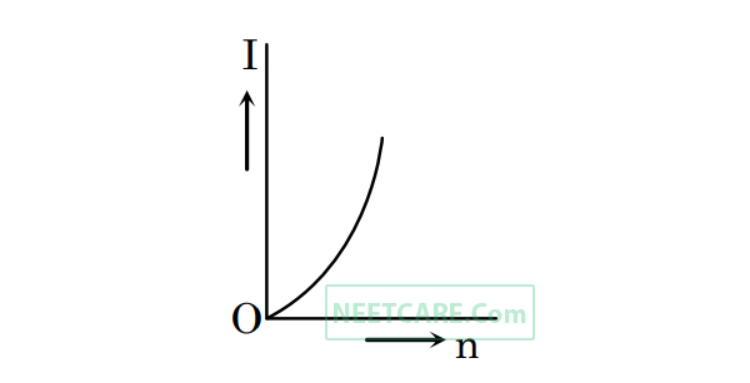
View answer and available explanation
Correct Option: A
Answer A follows the ExamSIDE indexed key. See the credited source; not independently verified against an official final key.
Q10Physics
A moving block having mass m, collides with
another stationary block having mass 4m. The
lighter block comes to rest after collision. When
the initial velocity of the lighter block is v, then
the value of coefficient of restitution (e) will be
A. 0.5
B. 0.25
C. 0.8
D. 0.4
View answer and available explanation
Correct Option: B
Answer B follows the ExamSIDE indexed key. See the credited source; not independently verified against an official final key.
Q11Physics
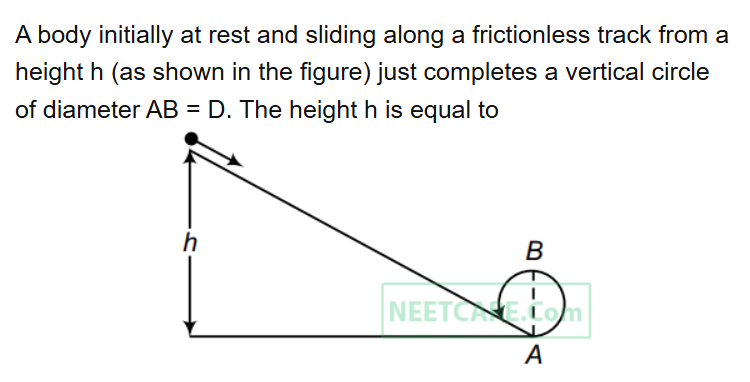
A. D
B. 
C. 
D. 
View answer and available explanation
Correct Option: D
Answer D follows the ExamSIDE indexed key. See the credited source; not independently verified against an official final key.
Q12Physics
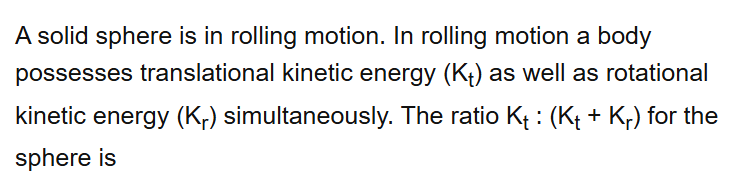
A. 7 : 10
B. 5 : 7
C. 10 : 7
D. 2 : 5
View answer and available explanation
Correct Option: B
Answer B follows the ExamSIDE indexed key. See the credited source; not independently verified against an official final key.
Q13Physics
The electrostatic force between the metal plates
of an isolated parallel plate capacitor C having
a charge Q and area A, is
A. Independent of the distance between the
plates
B. Linearly proportional to the distance
between the plates
C. Proportional to the square root of the
distance between the plates
D. Inversely proportional to the distance
between the plates
View answer and available explanation
Correct Option: A
Answer A follows the ExamSIDE indexed key. See the credited source; not independently verified against an official final key.
Q14Physics
The ratio of kinetic energy to the total energy
of an electron in a Bohr orbit of the hydrogen
atom, is
A. 1 : 1
B. 1 : -1
C. 2 : -1
D. 1 : -2
View answer and available explanation
Correct Option: B
Answer B follows the ExamSIDE indexed key. See the credited source; not independently verified against an official final key.
Q15Physics
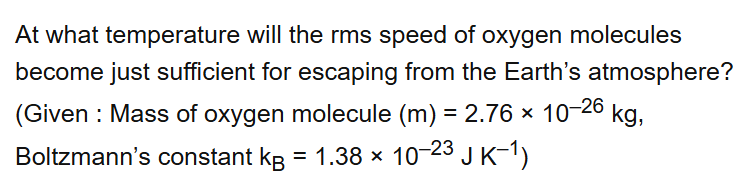
A. 
B. 
C. 
D. 
View answer and available explanation
Correct Option: B
Answer B follows the ExamSIDE indexed key. See the credited source; not independently verified against an official final key.
Q16Physics
A set of n equal resistors, of value R each, are
connected in series to a battery of emf E and
internal resistance R. The current drawn is I. Now,
the n resistors are connected in parallel to the
same battery. Then the current drawn from battery
becomes 10I. The value of n is
A. 10
B. 11
C. 20
D. 9
View answer and available explanation
Correct Option: A
Answer A follows the ExamSIDE indexed key. See the credited source; not independently verified against an official final key.
Q17Physics
The efficiency of an ideal heat engine working
between the freezing point and boiling point
of water, is
A. 26.8%
B. 20%
C. 6.25%
D. 12.5%
View answer and available explanation
Correct Option: A
Answer A follows the ExamSIDE indexed key. See the credited source; not independently verified against an official final key.
Q18Physics
Current sensitivity of a moving coil
galvanometer is 5 div/mA and its voltage
sensitivity (angular deflection per unit voltage
applied) is 20 div/V. The resistance of the
galvanometer is
A. 
B. 
C. 
D. 
View answer and available explanation
Correct Option: C
Answer C follows the ExamSIDE indexed key. See the credited source; not independently verified against an official final key.
Q19Physics

A. 0.79 W
B. 0.43 W
C. 2.74 W
D. 1.13 W
View answer and available explanation
Correct Option: A
Answer A follows the ExamSIDE indexed key. See the credited source; not independently verified against an official final key.
Q20Physics
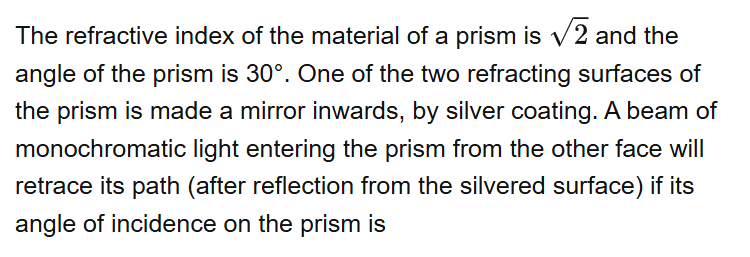
A. 
B. 
C. 
D. zero
View answer and available explanation
Correct Option: B
Answer B follows the ExamSIDE indexed key. See the credited source; not independently verified against an official final key.
Q21Physics
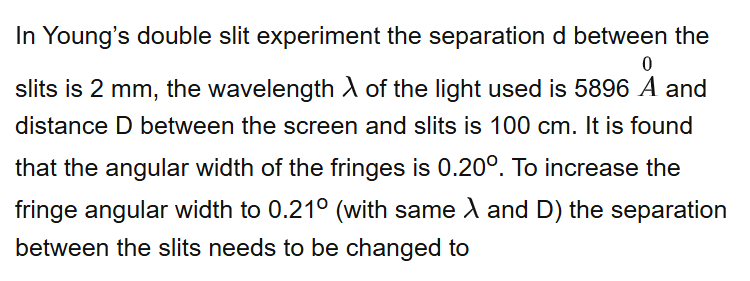
A. 1.9 mm
B. 1.8 mm
C. 2.1 mm
D. 1.7 mm
View answer and available explanation
Correct Option: A
Answer A follows the ExamSIDE indexed key. See the credited source; not independently verified against an official final key.
Q22Physics
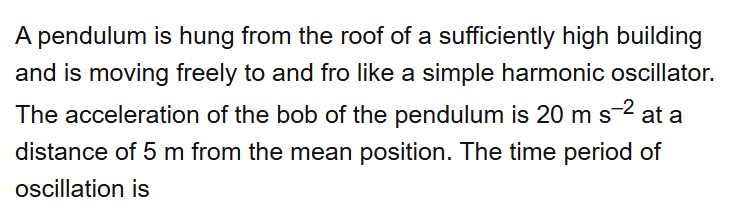
A. 
B. 
C. 2 s
D. 1 s
View answer and available explanation
Correct Option: B
Answer B follows the ExamSIDE indexed key. See the credited source; not independently verified against an official final key.
Q23Physics
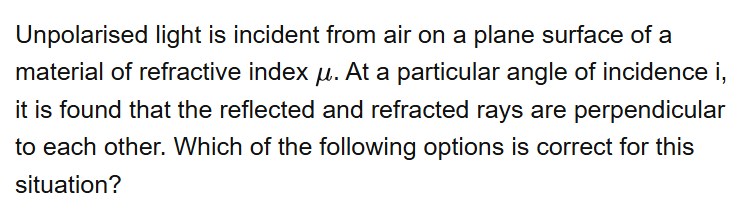
A. Reflected light is polarised with its electric
vector parallel to the plane of incidence
B. Reflected light is polarised with its electric
vector perpendicular to the plane of
incidence
C. 
D. 
View answer and available explanation
Correct Option: B
Answer B follows the ExamSIDE indexed key. See the credited source; not independently verified against an official final key.
Q24Physics
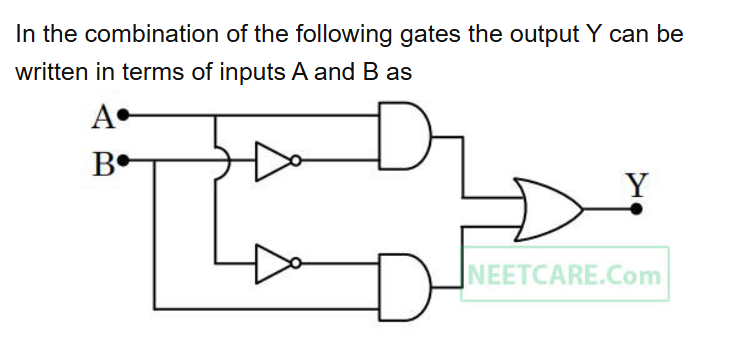
A. 
B. 
C. 
D. 
View answer and available explanation
Correct Option: B
Answer B follows the ExamSIDE indexed key. See the credited source; not independently verified against an official final key.
Q25Physics
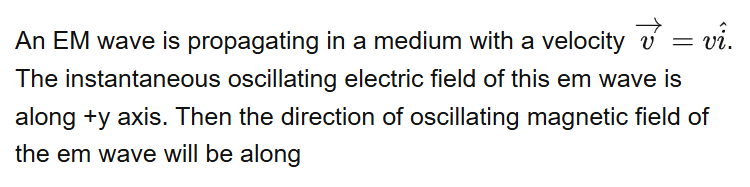
A. z direction
B. +z direction
C. –y direction
D. –x direction
View answer and available explanation
Correct Option: B
Answer B follows the ExamSIDE indexed key. See the credited source; not independently verified against an official final key.
Q26Physics
An astronomical refracting telescope will have
large angular magnification and high angular
resolution, when it has an objective lens of
A. small focal length and large diameter
B. large focal length and small diameter
C. large focal length and large diameter
D. small focal length and small diameter
View answer and available explanation
Correct Option: C
Answer C follows the ExamSIDE indexed key. See the credited source; not independently verified against an official final key.
Q27Physics
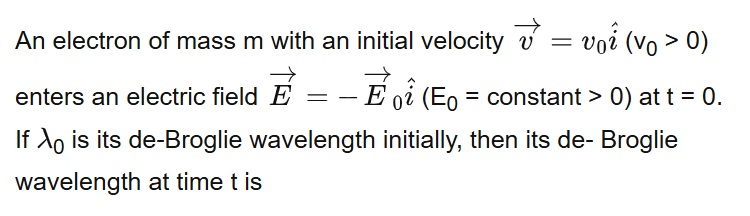
A. 
B. 
C. 
D. 
View answer and available explanation
Correct Option: A
Answer A follows the ExamSIDE indexed key. See the credited source; not independently verified against an official final key.
Q28Physics
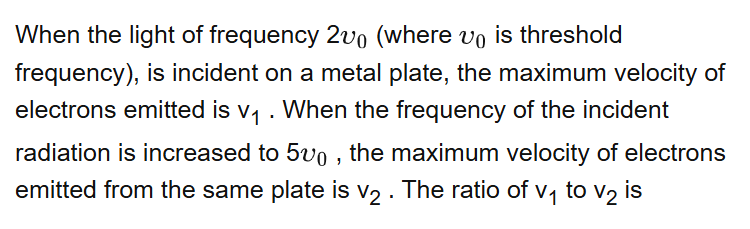
A. 1 : 2
B. 1 : 4
C. 4 : 1
D. 2 : 1
View answer and available explanation
Correct Option: A
Answer A follows the ExamSIDE indexed key. See the credited source; not independently verified against an official final key.
Q29Physics
An object is placed at a distance of 40 cm
from a concave mirror of focal length 15 cm.
If the object is displaced through a distance
of 20 cm towards the mirror, the displacement
of the image will be
A. 30 cm away from the mirror
B. 36 cm away from the mirror
C. 30 cm towards the mirror
D. 36 cm towards the mirror
View answer and available explanation
Correct Option: B
Answer B follows the ExamSIDE indexed key. See the credited source; not independently verified against an official final key.
Q30Physics
In a p-n junction diode, change in temperature
due to heating
A. affects only reverse resistance
B. affects only forward resistance
C. does not affect resistance of p-n junction
D. affects the overall V - I characteristics of
p-n junction
View answer and available explanation
Correct Option: D
Answer D follows the ExamSIDE indexed key. See the credited source; not independently verified against an official final key.
Q31Physics
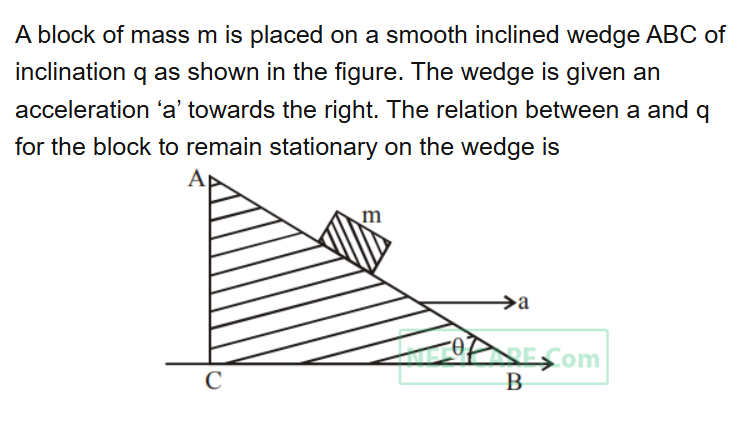
A. 
B. 
C. 
D. 
View answer and available explanation
Correct Option: D
Answer D follows the ExamSIDE indexed key. See the credited source; not independently verified against an official final key.
Q32Physics
The fundamental frequency in an open organ
pipe is equal to the third harmonic of a closed
organ pipe. If the length of the closed organ
pipe is 20 cm, the length of the open organ
pipe is
A. 13.2 cm
B. 8 cm
C. 12.5 cm
D. 16 cm
View answer and available explanation
Correct Option: A
Answer A follows the ExamSIDE indexed key. See the credited source; not independently verified against an official final key.
Q33Physics
A student measured the diameter of a small
steel ball using a screw gauge of least count
0.001 cm. The main scale reading is 5 mm and
zero of circular scale division coincides with
25 divisions above the reference level. If screw
gauge has a zero error of –0.004 cm, the correct
diameter of the ball is
A. 0.521 cm
B. 0.525 cm
C. 0.053 cm
D. 0.529 cm
View answer and available explanation
Correct Option: D
Answer D follows the ExamSIDE indexed key. See the credited source; not independently verified against an official final key.
Q34Physics
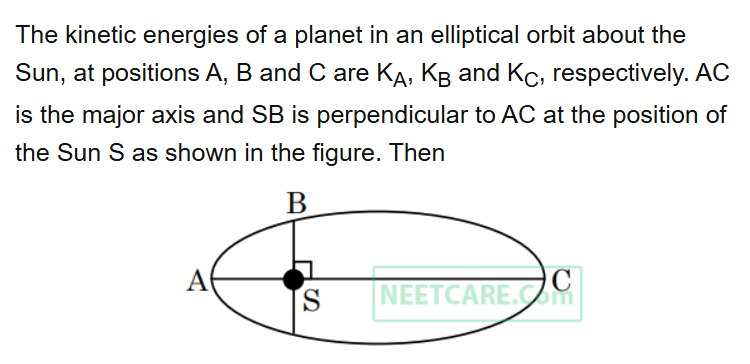
A. 
B. 
C. 
D. 
View answer and available explanation
Correct Option: B
Answer B follows the ExamSIDE indexed key. See the credited source; not independently verified against an official final key.
Q35Physics
Which one of the following statements is
incorrect?
A. Rolling friction is smaller than sliding
friction.
B. Limiting value of static friction is directly
proportional to normal reaction.
C. Frictional force opposes the relative
motion.
D. Coefficient of sliding friction has dimensions
of length.
View answer and available explanation
Correct Option: D
Answer D follows the ExamSIDE indexed key. See the credited source; not independently verified against an official final key.
Q36Physics
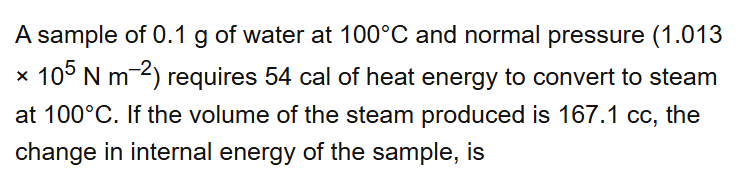
A. 104.3 J
B. 208.7 J
C. 42.2 J
D. 84.5 J
View answer and available explanation
Correct Option: B
Answer B follows the ExamSIDE indexed key. See the credited source; not independently verified against an official final key.
Q37Physics
A thin diamagnetic rod is placed vertically
between the poles of an electromagnet. When
the current in the electromagnet is switched
on, then the diamagnetic rod is pushed up, out
of the horizontal magnetic field. Hence the rod
gains gravitational potential energy. The work
required to do this comes from
A. The current source
B. The magnetic field
C. The lattice structure of the material of the rod
D. The induced electric field due to the
changing magnetic field
View answer and available explanation
Correct Option: A
Answer A follows the ExamSIDE indexed key. See the credited source; not independently verified against an official final key.
Q38Physics
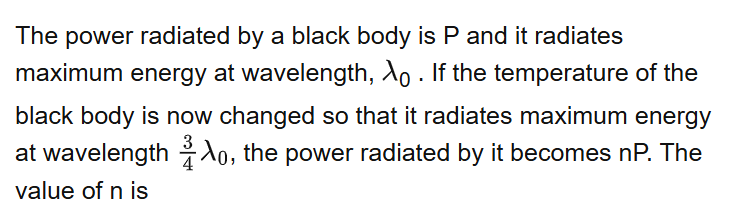
A. 
B. 
C. 
D. 
View answer and available explanation
Correct Option: C
Answer C follows the ExamSIDE indexed key. See the credited source; not independently verified against an official final key.
Q39Physics
A solid sphere is rotating freely about its
symmetry axis in free space. The radius of
the sphere is increased keeping its mass same.
Which of the following physical quantities
would remain constant for the sphere?
A. Angular velocity
B. Moment of inertia
C. Rotational kinetic energy
D. Angular momentum
View answer and available explanation
Correct Option: D
Answer D follows the ExamSIDE indexed key. See the credited source; not independently verified against an official final key.
Q40Physics
A tuning fork is used to produce resonance in
a glass tube. The length of the air column in
this tube can be adjusted by a variable piston.
At room temperature of 27°C two successive
resonances are produced at 20 cm and 73 cm
of column length. If the frequency of the tuning
fork is 320 Hz, the velocity of sound in air at
27°C is
A. 
B. 
C. 
D. 
View answer and available explanation
Correct Option: B
Answer B follows the ExamSIDE indexed key. See the credited source; not independently verified against an official final key.
Q41Physics
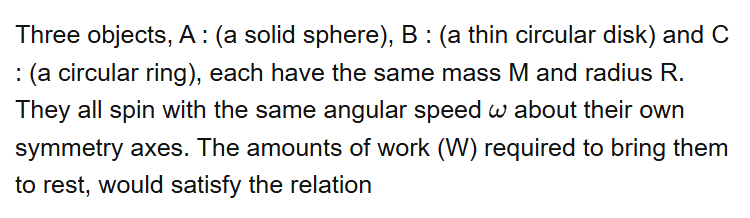
A. 
B. 
C. 
D. 
View answer and available explanation
Correct Option: A
Answer A follows the ExamSIDE indexed key. See the credited source; not independently verified against an official final key.
Q42Physics

A. 
B. 
C. 
D. 
View answer and available explanation
Correct Option: D
Answer D follows the ExamSIDE indexed key. See the credited source; not independently verified against an official final key.
Q43Physics
A small sphere of radius ‘r’ falls from rest in a
viscous liquid. As a result, heat is produced
due to viscous force. The rate of production of
heat when the sphere attains its terminal velocity,
is proportional to
A. 
B. 
C. 
D. 
View answer and available explanation
Correct Option: C
Answer C follows the ExamSIDE indexed key. See the credited source; not independently verified against an official final key.
Q44Chemistry
The difference between amylose and amylopectin
is
A. 
B. 
C. 
D. amylose is made up of glucose and
galactose
View answer and available explanation
Correct Option: A
Answer A follows the ExamSIDE indexed key. See the credited source; not independently verified against an official final key.
Q45Chemistry
A. B
B. A
C. D
D. C
View answer and available explanation
Correct Option: D
Answer D follows the ExamSIDE indexed key. See the credited source; not independently verified against an official final key.
Q46Chemistry

A. square planar geometry and diamagnetic
B. tetrahedral geometry and diamagnetic
C. square planar geometry and paramagnetic
D. tetrahedral geometry and paramagnetic.
View answer and available explanation
Correct Option: B
Answer B follows the ExamSIDE indexed key. See the credited source; not independently verified against an official final key.
Q47Chemistry

A. 
B. 
C. 
D. 
View answer and available explanation
Correct Option: D
Answer D follows the ExamSIDE indexed key. See the credited source; not independently verified against an official final key.
Q48Chemistry

A. one
B. two
C. four
D. three
View answer and available explanation
Correct Option: B
Answer B follows the ExamSIDE indexed key. See the credited source; not independently verified against an official final key.
Q49Chemistry
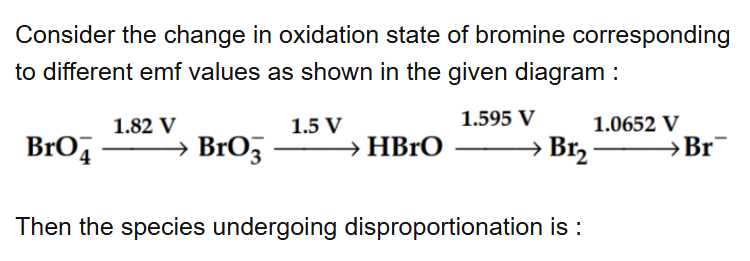
A. 
B. 
C. 
D. HBrO
View answer and available explanation
Correct Option: D
Answer D follows the ExamSIDE indexed key. See the credited source; not independently verified against an official final key.
Q50Chemistry

A. geometrical isomerism
B. coordination isomerism
C. ionization isomerism
D. linkage isomerism.
View answer and available explanation
Correct Option: A
Answer A follows the ExamSIDE indexed key. See the credited source; not independently verified against an official final key.
Q51Chemistry

A. 
B. 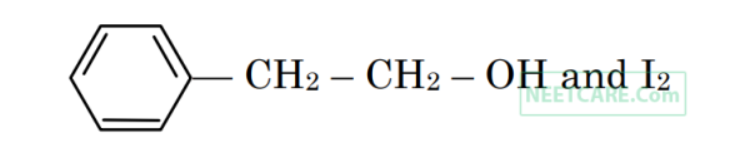
C. 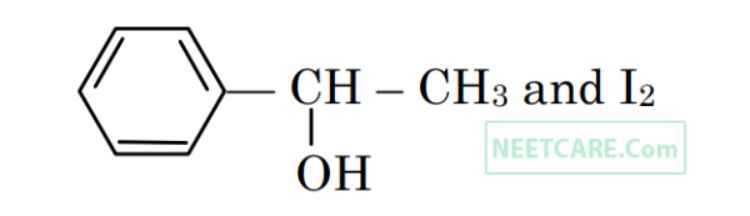
D. 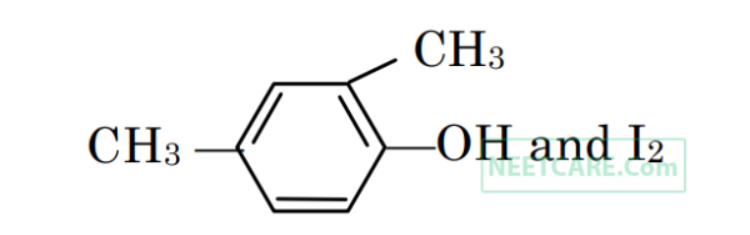
View answer and available explanation
Correct Option: C
Answer C follows the ExamSIDE indexed key. See the credited source; not independently verified against an official final key.
Q52Chemistry
In which case is number of molecules of water
maximum?
A. 18 mL of water
B. 0.18 g of water
C. 0.00224 L of water vapours at 1 atm and 273 K
D. 
View answer and available explanation
Correct Option: A
Answer A follows the ExamSIDE indexed key. See the credited source; not independently verified against an official final key.
Q53Chemistry
Which one is a wrong statement?
A. Total orbital angular momentum of electron
in s-orbital is equal to zero.
B. An orbital is designated by three quantum
numbers while an electron in an atom is
designated by four quantum numbers
C. 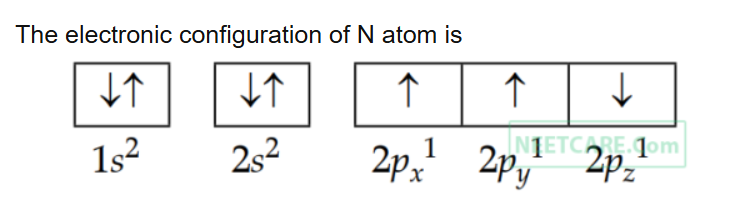
D. 
View answer and available explanation
Correct Option: C
Answer C follows the ExamSIDE indexed key. See the credited source; not independently verified against an official final key.
Q54Chemistry

A. Low temperature and high pressure
B. Low temperature and low pressure
C. High temperature and high pressure
D. High temperature and low pressure
View answer and available explanation
Correct Option: A
Answer A follows the ExamSIDE indexed key. See the credited source; not independently verified against an official final key.
Q55Chemistry
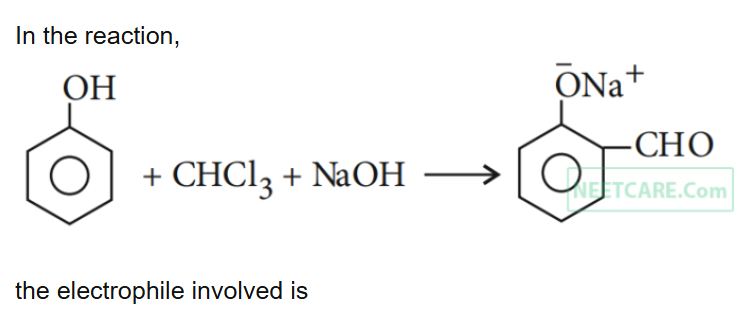
A. 
B. 
C. 
D. 
View answer and available explanation
Correct Option: D
Answer D follows the ExamSIDE indexed key. See the credited source; not independently verified against an official final key.
Q56Chemistry
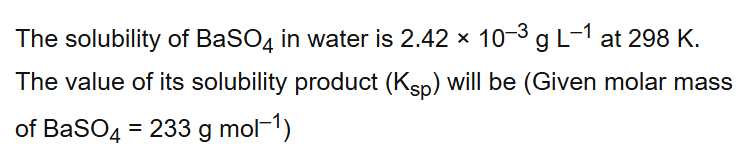
A. 
B. 
C. 
D. 
View answer and available explanation
Correct Option: A
Answer A follows the ExamSIDE indexed key. See the credited source; not independently verified against an official final key.
Q57Chemistry
The correct order of N-compounds in its
decreasing order of oxidation states is
A. 
B. 
C. 
D. 
View answer and available explanation
Correct Option: A
Answer A follows the ExamSIDE indexed key. See the credited source; not independently verified against an official final key.
Q58Chemistry
When initial concentration of the reactant is
doubled, the half-life period of a zero order
reaction
A. is halved
B. is doubled
C. is tripled
D. remains unchanged.
View answer and available explanation
Correct Option: B
Answer B follows the ExamSIDE indexed key. See the credited source; not independently verified against an official final key.
Q59Chemistry

A. NO
B. 
C. 
D. NO
View answer and available explanation
Correct Option: B
Answer B follows the ExamSIDE indexed key. See the credited source; not independently verified against an official final key.
Q60Chemistry
The correct order of atomic radii in group 13
elements is
A. B < Al < In < Ga < Tl
B. B < Al < Ga < In < Tl
C. B < Ga < Al < Tl < In
D. B < Ga < Al < In < Tl
View answer and available explanation
Correct Option: D
Answer D follows the ExamSIDE indexed key. See the credited source; not independently verified against an official final key.
Q61Chemistry
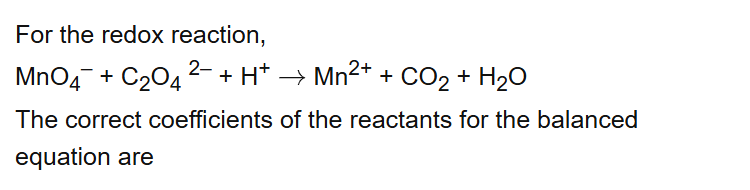
A. 
B. 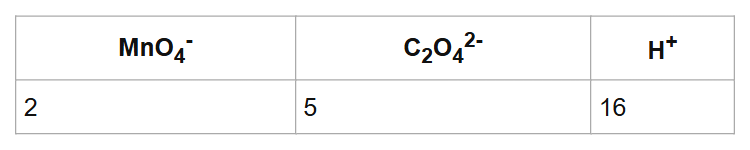
C. 
D. 
View answer and available explanation
Correct Option: B
Answer B follows the ExamSIDE indexed key. See the credited source; not independently verified against an official final key.
Q62Chemistry

A. tetranuclear
B. mononuclear
C. trinuclear
D. dinuclear
View answer and available explanation
Correct Option: B
Answer B follows the ExamSIDE indexed key. See the credited source; not independently verified against an official final key.
Q63Chemistry
Nitration of aniline in strong acidic medium
also gives m-nitroaniline because
A. inspite of substituents nitro group always
goes to only m-position
B. in electrophilic substitution reactions
amino group is meta directive
C. in absence of substituents nitro group
always goes to m-position
D. in acidic (strong) medium aniline is present
as anilinium ion.
View answer and available explanation
Correct Option: D
Answer D follows the ExamSIDE indexed key. See the credited source; not independently verified against an official final key.
Q64Chemistry
Which of the following compounds can form a
zwitter ion?
A. Aniline
B. Acetanilide
C. Benzoic acid
D. Glycine
View answer and available explanation
Correct Option: D
Answer D follows the ExamSIDE indexed key. See the credited source; not independently verified against an official final key.
Q65Chemistry
Which of the following statements is not true
for halogens?
A. All are oxidizing agents.
B. All form monobasic oxyacids.
C. All but fluorine show positive oxidation
states.
D. Chlorine has the highest electron-gain
enthalpy.
View answer and available explanation
Correct Option: C
Answer C follows the ExamSIDE indexed key. See the credited source; not independently verified against an official final key.
Q66Chemistry
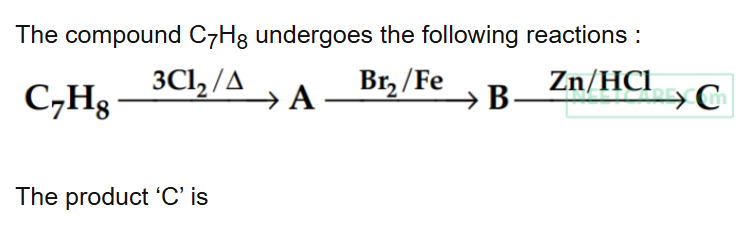
A. m–bromotoluene
B. o–bromotoluene
C. 3–bromo–2,4,6–trichlorotoluene
D. p–bromotoluene
View answer and available explanation
Correct Option: A
Answer A follows the ExamSIDE indexed key. See the credited source; not independently verified against an official final key.
Q67Chemistry
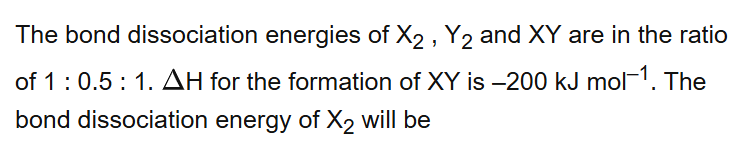
A. 
B. 
C. 
D. 
View answer and available explanation
Correct Option: A
Answer A follows the ExamSIDE indexed key. See the credited source; not independently verified against an official final key.
Q68Chemistry
Which one of the following ions exhibits d-d
transition and paramagnetism as well?
A. 
B. 
C. 
D. 
View answer and available explanation
Correct Option: D
Answer D follows the ExamSIDE indexed key. See the credited source; not independently verified against an official final key.
Q69Chemistry
Carboxylic acids have higher boiling points
than aldehydes, ketones and even alcohols of
comparable molecular mass. It is due to their
A. formation of intramolecular H-bonding
B. formation of carboxylate ion
C. more extensive association of carboxylic
acid via van der Waals’ forces of attraction
D. formation of intermolecular H-bonding.
View answer and available explanation
Correct Option: D
Answer D follows the ExamSIDE indexed key. See the credited source; not independently verified against an official final key.
Q70Chemistry
Which of the following carbocations is
expected to be most stable?
A. 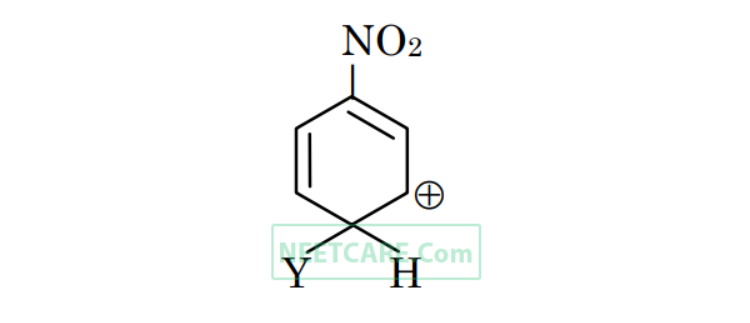
B. 
C. 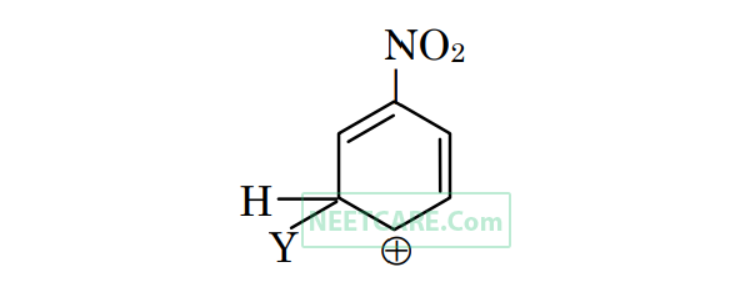
D. 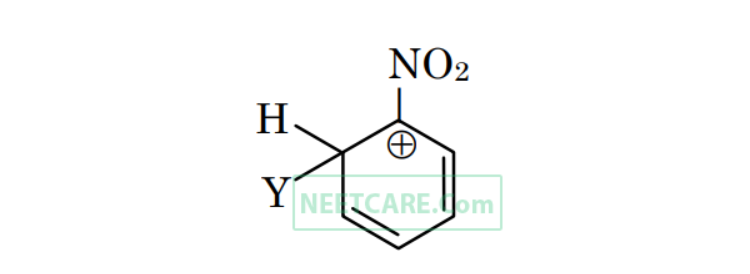
View answer and available explanation
Correct Option: C
Answer C follows the ExamSIDE indexed key. See the credited source; not independently verified against an official final key.
Q71Chemistry

A. Ga
B. Al
C. B
D. In
View answer and available explanation
Correct Option: C
Answer C follows the ExamSIDE indexed key. See the credited source; not independently verified against an official final key.
Q72Chemistry

A. 
B. 
C. 
D. 
View answer and available explanation
Correct Option: B
Answer B follows the ExamSIDE indexed key. See the credited source; not independently verified against an official final key.
Q73Chemistry
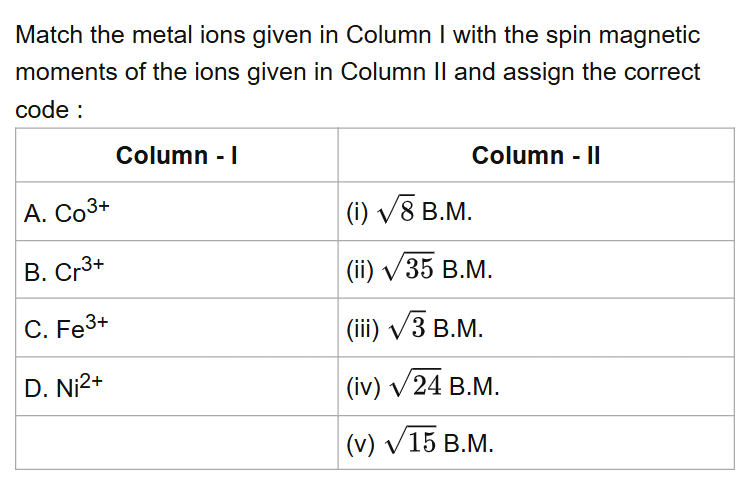
A. 
B. 
C. 
D. 
View answer and available explanation
Correct Option: A
Answer A follows the ExamSIDE indexed key. See the credited source; not independently verified against an official final key.
Q74Chemistry
Hydrocarbon (A) reacts with bromine by
substitution to form an alkyl bromide which by
Wurtz reaction is converted to gaseous
hydrocarbon containing less than four carbon
atoms. (A) is
A. 
B. 
C. 
D. 
View answer and available explanation
Correct Option: D
Answer D follows the ExamSIDE indexed key. See the credited source; not independently verified against an official final key.
Q75Chemistry
Which of the following oxides is most acidic in
nature?
A. MgO
B. BeO
C. BaO
D. CaO
View answer and available explanation
Correct Option: B
Answer B follows the ExamSIDE indexed key. See the credited source; not independently verified against an official final key.
Q76Chemistry
The correct difference between first and
second order reactions is that
A. the rate of a first-order reaction does not
depend on reactant concentrations; the
rate of a second-order reaction does
depend on reactant concentrations
B. ![the half-life of a first-order reaction does
not depend on [A]0 ; the half-life of a second order reaction does depend on [A]0](/Content/pyq/neet/neet-2018-j2e5jeaod6oiaatf3q1qpqahkka1156sa-2.png)
C. a first-order reaction can be catalysed; a
second-order reaction cannot be catalysed
D. the rate of a first-order reaction does
depend on reactant concentrations; the
rate of a second-order reaction does not
depend on reactant concentrations
View answer and available explanation
Correct Option: B
Answer B follows the ExamSIDE indexed key. See the credited source; not independently verified against an official final key.
Q77Chemistry
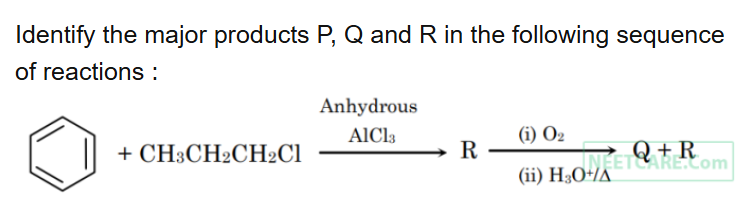
A. 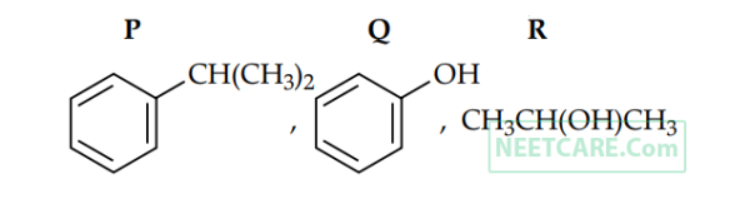
B. 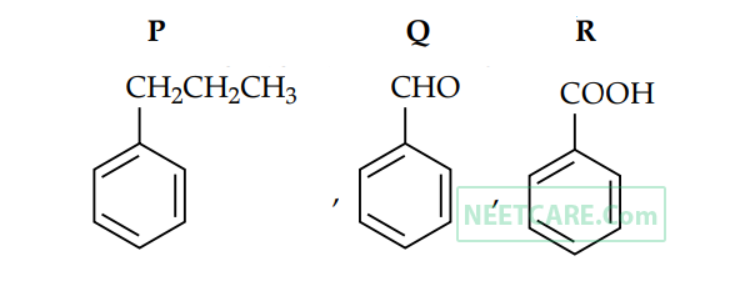
C. 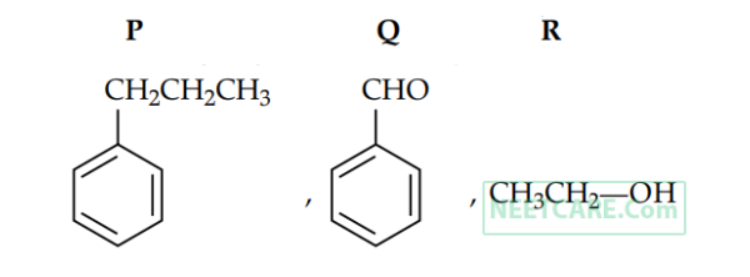
D. 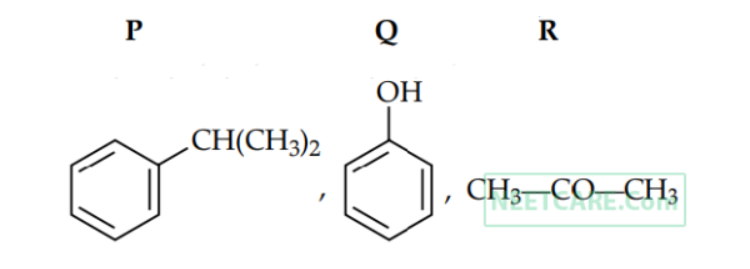
View answer and available explanation
Correct Option: D
Answer D follows the ExamSIDE indexed key. See the credited source; not independently verified against an official final key.
Q78Chemistry
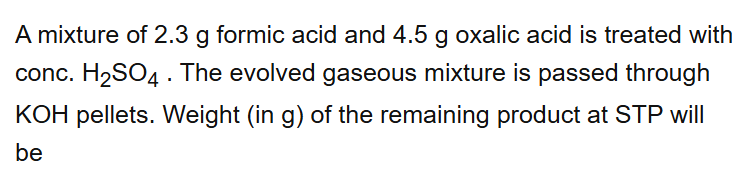
A. 1.4
B. 3.0
C. 2.8
D. 4.4
View answer and available explanation
Correct Option: C
Answer C follows the ExamSIDE indexed key. See the credited source; not independently verified against an official final key.
Q79Biology
What type of ecological pyramid would be
obtained with the following data?
Secondary consumer : 120 g
Primary consumer : 60 g
Primary producer : 10 g
A. Inverted pyramid of biomass
B. Pyramid of energy
C. Upright pyramid of numbers
D. Upright pyramid of biomass
View answer and available explanation
Correct Option: A
Answer A follows the ExamSIDE indexed key. See the credited source; not independently verified against an official final key.
Q80Biology
All of the following are included in ‘ex-situ
conservation’ except
A. wildlife safari parks
B. sacred groves
C. botanical gardens
D. seed banks
View answer and available explanation
Correct Option: B
Answer B follows the ExamSIDE indexed key. See the credited source; not independently verified against an official final key.
Q81Biology
Pollen grains can be stored for several years
in liquid nitrogen having a temperature of
A. 
B. 
C. 
D. 
View answer and available explanation
Correct Option: C
Answer C follows the ExamSIDE indexed key. See the credited source; not independently verified against an official final key.
Q82Biology
Natality refers to
A. death rate
B. birth rate
C. number of individuals leaving the habitat
D. number of individuals entering a habitat
View answer and available explanation
Correct Option: B
Answer B follows the ExamSIDE indexed key. See the credited source; not independently verified against an official final key.
Q83Biology
In a growing population of a country,
A. pre-reproductive individuals are more than
the reproductive individuals
B. reproductive individuals are less than the
post-reproductive individuals
C. reproductive and pre-reproductive
individuals are equal in number
D. pre-reproductive individuals are less than
the reproductive individuals.
View answer and available explanation
Correct Option: A
Answer A follows the ExamSIDE indexed key. See the credited source; not independently verified against an official final key.
Q84Biology
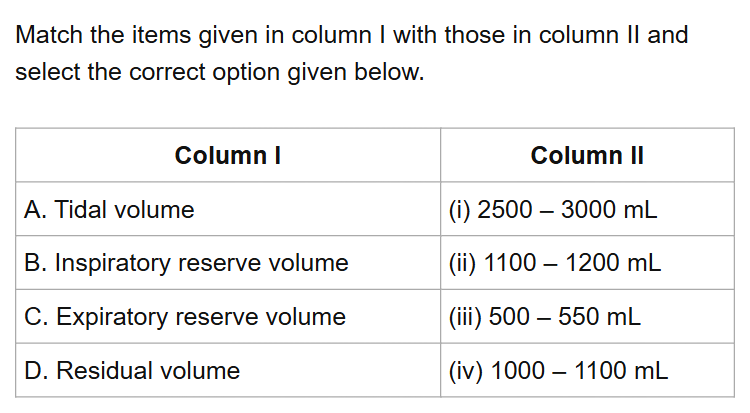
A. 
B. 
C. 
D. 
View answer and available explanation
Correct Option: A
Answer A follows the ExamSIDE indexed key. See the credited source; not independently verified against an official final key.
Q85Biology
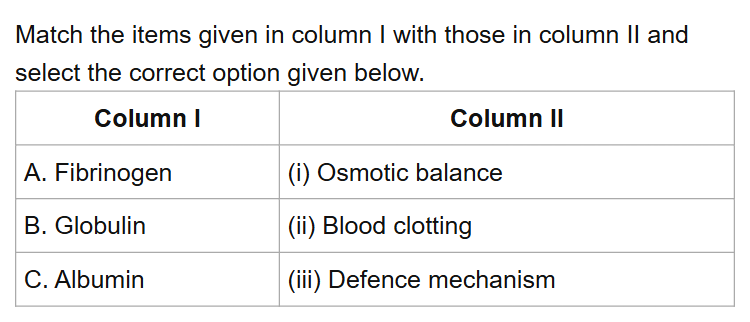
A. 
B. 
C. 
D. 
View answer and available explanation
Correct Option: C
Answer C follows the ExamSIDE indexed key. See the credited source; not independently verified against an official final key.
Q86Biology
Which of the following hormones can play a
significant role in osteoporosis?
A. Estrogen and parathyroid hormone
B. Aldosterone and prolactin
C. Progesterone and aldosterone
D. Parathyroid hormone and prolactin
View answer and available explanation
Correct Option: A
Answer A follows the ExamSIDE indexed key. See the credited source; not independently verified against an official final key.
Q87Biology
Which of these statements is incorrect?
A. Glycolysis operates as long as it is supplied
with NAD that can pick up hydrogen atoms.
B. Enzymes of TCA cycle are present in
mitochondrial matrix.
C. Oxidative phosphorylation takes place in
outer mitochondrial membrane.
D. Glycolysis occurs in cytosol.
View answer and available explanation
Correct Option: C
Answer C follows the ExamSIDE indexed key. See the credited source; not independently verified against an official final key.
Q88Biology
Nissl’s bodies are mainly composed of
A. free ribosomes and RER
B. proteins and lipids
C. DNA and RNA
D. nucleic acids and SER
View answer and available explanation
Correct Option: A
Answer A follows the ExamSIDE indexed key. See the credited source; not independently verified against an official final key.
Q89Biology
Which of the following options correctly
represents the lung conditions in asthma and
emphysema, respectively?
A. Decreased respiratory surface; Inflammation
of bronchioles
B. Inflammation of bronchioles; Decreased
respiratory surface
C. Increased number of bronchioles; Increased
respiratory surface
D. Increased respiratory surface; Inflammation
of bronchioles
View answer and available explanation
Correct Option: B
Answer B follows the ExamSIDE indexed key. See the credited source; not independently verified against an official final key.
Q90Biology
Casparian strips occur in
A. pericycle
B. epidermis
C. endodermis.
D. cortex
View answer and available explanation
Correct Option: C
Answer C follows the ExamSIDE indexed key. See the credited source; not independently verified against an official final key.
Q91Biology
Plants having little or no secondary growth are
A. deciduous angiosperms
B. grasses
C. cycads
D. conifers
View answer and available explanation
Correct Option: B
Answer B follows the ExamSIDE indexed key. See the credited source; not independently verified against an official final key.
Q92Biology
Which of the following events does not occur
in rough endoplasmic reticulum?
A. Cleavage of signal peptide
B. Phospholipid synthesis
C. Protein folding
D. Protein glycosylation
View answer and available explanation
Correct Option: B
Answer B follows the ExamSIDE indexed key. See the credited source; not independently verified against an official final key.
Q93Biology
Which of the following is an occupational
respiratory disorder?
A. Botulism
B. Anthracis
C. Silicosis
D. Emphysema
View answer and available explanation
Correct Option: C
Answer C follows the ExamSIDE indexed key. See the credited source; not independently verified against an official final key.
Q94Biology
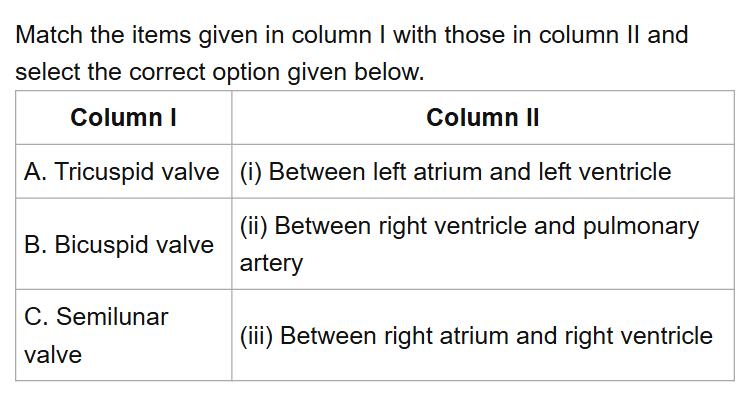
A. 
B. 
C. 
D. 
View answer and available explanation
Correct Option: B
Answer B follows the ExamSIDE indexed key. See the credited source; not independently verified against an official final key.
Q95Biology
Select the wrong statement.
A. Mushrooms belong to basidiomycetes.
B. Cell wall is present in members of fungi and plantae.
C. Pseudopodia are locomotory and feeding structures in sporozoans.
D. Mitochondria are the powerhouse of the cell in all kingdoms except monera.
View answer and available explanation
Correct Option: C
Answer C follows the ExamSIDE indexed key. See the credited source; not independently verified against an official final key.
Q96Biology
Oxygen is not produced during photosynthesis by
A. Cycas
B. Green sulphur bacteria
C. Chara
D. Nostoc
View answer and available explanation
Correct Option: B
Answer B follows the ExamSIDE indexed key. See the credited source; not independently verified against an official final key.
Q97Biology
Which of the following organisms are known as chief producers in the oceans?
A. Euglenoids
B. Cyanobacteria
C. Dinoflagellates
D. Diatoms
View answer and available explanation
Correct Option: D
Answer D follows the ExamSIDE indexed key. See the credited source; not independently verified against an official final key.
Q98Biology
Sweet potato is a modified
A. adventitious root
B. rhizome
C. stem
D. taproot
View answer and available explanation
Correct Option: A
Answer A follows the ExamSIDE indexed key. See the credited source; not independently verified against an official final key.
Q99Biology
Calcium is important in skeletal muscle
contraction because it
A. detaches the myosin head from the actin
filament
B. binds to troponin to remove the masking of
active sites on actin for myosin
C. prevents the formation of bonds between the
myosin cross bridges and the actin filament.
D. activates the myosin ATPase by binding to it
View answer and available explanation
Correct Option: B
Answer B follows the ExamSIDE indexed key. See the credited source; not independently verified against an official final key.
Q100Biology
After karyogamy followed by meiosis, spores are produced exogenously in
A. Saccharomyces.
B. Neurospora
C. Alternaria
D. Agaricus
View answer and available explanation
Correct Option: D
Answer D follows the ExamSIDE indexed key. See the credited source; not independently verified against an official final key.
Q101Biology
The stage during which separation of the paired
homologous chromosomes begins is
A. zygotene.
B. pachytene
C. diplotene
D. diakinesis
View answer and available explanation
Correct Option: C
Answer C follows the ExamSIDE indexed key. See the credited source; not independently verified against an official final key.
Q102Biology
Which of the following structures or regions is
incorrectly paired with its functions?
A. Medulla oblongata : Controls respiration and cardiovascular reflexes
B. Corpus callosum : Band of fibers connecting
left and right cerebral
hemispheres
C. Hypothalamus : Production of releasing
hormones and regulation
of temperature, hunger
and thirst
D. Limbic system : Consists of fibre tracts
that interconnect
different regions of
brain controlsmovement
View answer and available explanation
Correct Option: D
Answer D follows the ExamSIDE indexed key. See the credited source; not independently verified against an official final key.
Q103Biology
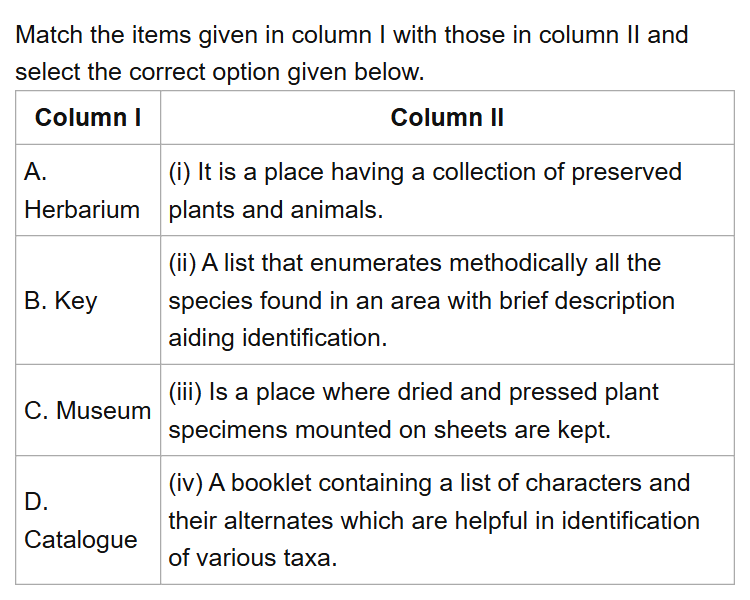
A. 
B. 
C. 
D. 
View answer and available explanation
Correct Option: C
Answer C follows the ExamSIDE indexed key. See the credited source; not independently verified against an official final key.
Q104Biology
Which of the following features is used to identify a male cockroach from a female cockroach?
A. Forewings with darker tegmina
B. Presence of caudal styles
C. Presence of anal cerci
D. 
View answer and available explanation
Correct Option: B
Answer B follows the ExamSIDE indexed key. See the credited source; not independently verified against an official final key.
Q105Biology
Which of the following is an amino acid derived
hormone?
A. Ecdysone
B. Estriol
C. Epinephrine
D. Estradiol
View answer and available explanation
Correct Option: C
Answer C follows the ExamSIDE indexed key. See the credited source; not independently verified against an official final key.
Q106Biology
Ciliates differ from all other protozoans in
A. having a contractile vacuole for removing excess water
B. having two types of nuclei.
C. using flagella for locomotion
D. using pseudopodia for capturing prey
View answer and available explanation
Correct Option: B
Answer B follows the ExamSIDE indexed key. See the credited source; not independently verified against an official final key.
Q107Biology
Stomata in grass leaf are
A. kidney-shaped
B. barrel-shaped
C. dumb-bell shaped
D. rectangular
View answer and available explanation
Correct Option: C
Answer C follows the ExamSIDE indexed key. See the credited source; not independently verified against an official final key.
Q108Biology
Which of the following statements is correct?
A. Selaginella is heterosporous, while Salvinia is homosporous.
B. Stems are usually unbranched in both Cycas and Cedrus
C. Ovules are not enclosed by ovary wall in gymnosperms
D. Horsetails are gymnosperms
View answer and available explanation
Correct Option: C
Answer C follows the ExamSIDE indexed key. See the credited source; not independently verified against an official final key.
Q109Biology
Identify the vertebrate group of animals characterised by crop and gizzard in its digestive system.
A. Amphibia
B. Osteichthyes
C. Reptilia
D. Aves
View answer and available explanation
Correct Option: D
Answer D follows the ExamSIDE indexed key. See the credited source; not independently verified against an official final key.
Q110Biology
Which one of these animals is not a homeotherm?
A. Chelone
B. Macropus
C. Psittacula
D. Camelus
View answer and available explanation
Correct Option: A
Answer A follows the ExamSIDE indexed key. See the credited source; not independently verified against an official final key.
Q111Biology
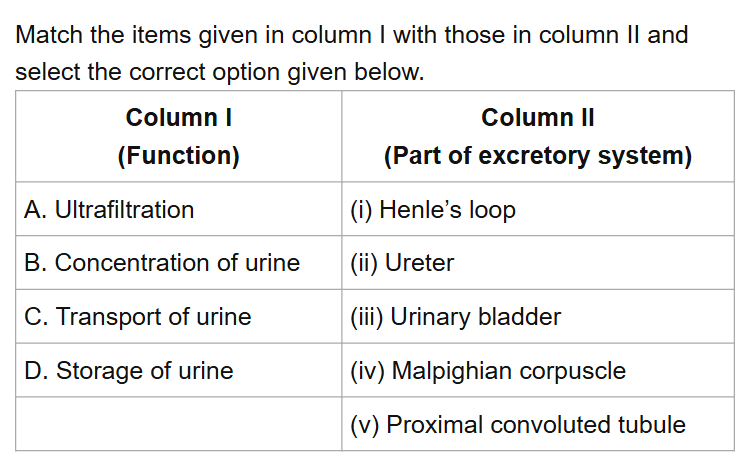
A. 
B. 
C. 
D. 
View answer and available explanation
Correct Option: A
Answer A follows the ExamSIDE indexed key. See the credited source; not independently verified against an official final key.
Q112Biology
Which of the following is true for nucleolus?
A. It takes part in spindle formation
B. Larger nucleoli are present in dividing cells.
C. It is a membrane-bound structure.
D. It is a site for active ribosomal RNA
synthesis.
View answer and available explanation
Correct Option: D
Answer D follows the ExamSIDE indexed key. See the credited source; not independently verified against an official final key.
Q113Biology
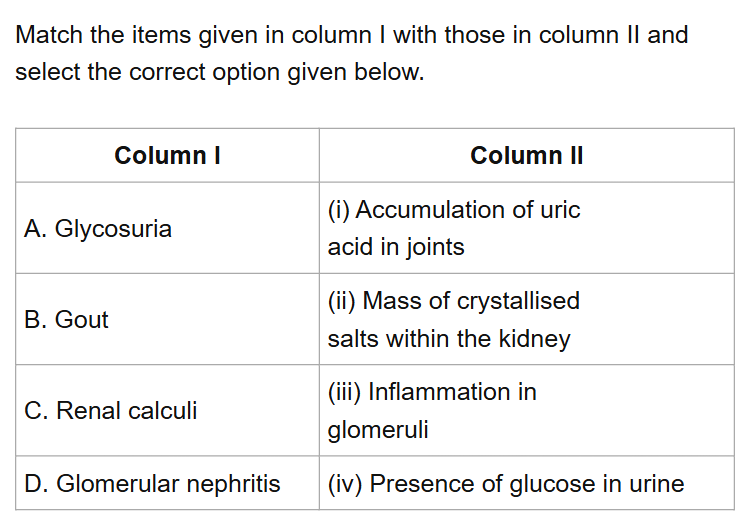
A. 
B. 
C. 
D. 
View answer and available explanation
Correct Option: A
Answer A follows the ExamSIDE indexed key. See the credited source; not independently verified against an official final key.
Q114Biology
Which among the following is not a prokaryote?
A. Mycobacterium
B. Saccharomyces
C. Oscillatoria
D. Nostoc
View answer and available explanation
Correct Option: B
Answer B follows the ExamSIDE indexed key. See the credited source; not independently verified against an official final key.
Q115Biology
Which one is wrongly matched?
A. Biflagellate zoospores – Brown algae
B. Uniflagellate gametes – Polysiphonia
C. Unicellular organism – Chlorella
D. Gemma cups – Marchantia
View answer and available explanation
Correct Option: B
Answer B follows the ExamSIDE indexed key. See the credited source; not independently verified against an official final key.
Q116Biology

A. It is the final electron acceptor for anaerobic
respiration.
B. It functions as an enzyme.
C. It functions as an electron carrier.
D. It is a nucleotide source for ATP synthesis.
View answer and available explanation
Correct Option: C
Answer C follows the ExamSIDE indexed key. See the credited source; not independently verified against an official final key.
Q117Biology
The Golgi complex participates in
A. activation of amino acid
B. fatty acid breakdown
C. formation of secretory vesicles
D. respiration in bacteria
View answer and available explanation
Correct Option: C
Answer C follows the ExamSIDE indexed key. See the credited source; not independently verified against an official final key.
Q118Biology
Secondary xylem and phloem in dicot stem are produced by
A. vascular cambium
B. axillary meristems
C. apical meristems
D. phellogen
View answer and available explanation
Correct Option: A
Answer A follows the ExamSIDE indexed key. See the credited source; not independently verified against an official final key.
Q119Biology
Select the incorrect match.
A. Allosomes – Sex chromosomes
B. Sub-metacentric chromosomes – L-shaped
chromosomes
C. Lampbrush chromosomes – Diplotene bivalents
D. Polytene chromosomes – Oocytes of
amphibians
View answer and available explanation
Correct Option: D
Answer D follows the ExamSIDE indexed key. See the credited source; not independently verified against an official final key.
Q120Biology
The two functional groups characteristic of
sugars are
A. carbonyl and methyl
B. carbonyl and hydroxyl.
C. hydroxyl and methyl
D. carbonyl and phosphate
View answer and available explanation
Correct Option: B
Answer B follows the ExamSIDE indexed key. See the credited source; not independently verified against an official final key.
Q121Biology
Which of the following is not a product of light
reaction of photosynthesis?
A. Oxygen
B. NADH
C. ATP
D. NADPH
View answer and available explanation
Correct Option: B
Answer B follows the ExamSIDE indexed key. See the credited source; not independently verified against an official final key.
Q122Biology
Which of the following has proved helpful in
preserving pollen as fossils?
A. Pollenkitt
B. Cellulosic intine
C. Oil content
D. Sporopollenin
View answer and available explanation
Correct Option: D
Answer D follows the ExamSIDE indexed key. See the credited source; not independently verified against an official final key.
Q123Biology
The similarity of bone structure in the forelimbs
of many vertebrates is an example of
A. homology
B. analogy
C. convergent evolution
D. adaptive radiation
View answer and available explanation
Correct Option: A
Answer A follows the ExamSIDE indexed key. See the credited source; not independently verified against an official final key.
Q124Biology
AGGTATCGCAT is a sequence from the coding
strand of a gene. What will be the corresponding
sequence of the transcribed mRNA?
A. AGGUAUCGCAU
B. UGGTUTCGCAT
C. ACCUAUGCGAU
D. UCCAUAGCGUA
View answer and available explanation
Correct Option: A
Answer A follows the ExamSIDE indexed key. See the credited source; not independently verified against an official final key.
Q125Biology
According to Hugo de Vries, the mechanism of
evolution is
A. multiple step mutations
B. saltation
C. phenotypic variations
D. minor mutations
View answer and available explanation
Correct Option: B
Answer B follows the ExamSIDE indexed key. See the credited source; not independently verified against an official final key.
Q126Biology
In India, the organisation responsible for
assessing the safety of introducing genetically
modified organisms for public use is
A. Indian Council of Medical Research (ICMR)
B. Council for Scientific and Industrial
Research (CSIR)
C. Research Committee on Genetic
Manipulation (RCGM)
D. Genetic Engineering Appraisal Committee
(GEAC)
View answer and available explanation
Correct Option: D
Answer D follows the ExamSIDE indexed key. See the credited source; not independently verified against an official final key.
Q127Biology
A 'new' variety of rice was patented by a
foreign company, though such varieties have
been present in India for a long time. This is
related to
A. Co-667
B. Sharbati Sonora
C. Lerma Rojo
D. Basmati
View answer and available explanation
Correct Option: D
Answer D follows the ExamSIDE indexed key. See the credited source; not independently verified against an official final key.
Q128Biology
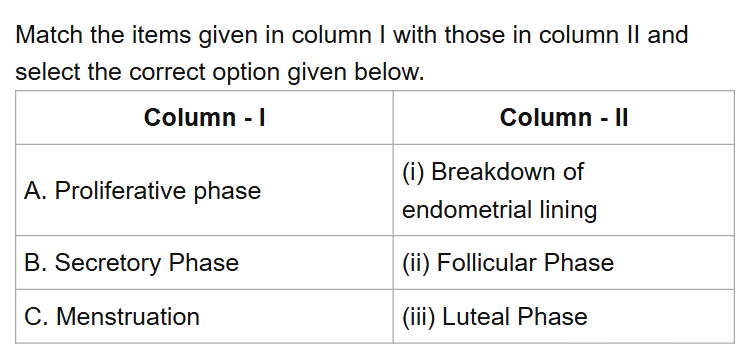
A. 
B. 
C. 
D. 
View answer and available explanation
Correct Option: C
Answer C follows the ExamSIDE indexed key. See the credited source; not independently verified against an official final key.
Q129Biology
Among the following sets of examples for
divergent evolution, select the incorrect option.
A. Forelimbs of man, bat and cheetah
B. Heart of bat, man and cheetah
C. Brain of bat, man and cheetah
D. Eye of octopus, bat and man
View answer and available explanation
Correct Option: D
Answer D follows the ExamSIDE indexed key. See the credited source; not independently verified against an official final key.
Q130Biology
Which of the following pairs is wrongly matched?
A. Starch synthesis in pea : Multiple alleles
B. ABO blood grouping : Co-dominance
C. XO type sex determination: Grasshopper
D. T.H. Morgan : Linkage
View answer and available explanation
Correct Option: A
Answer A follows the ExamSIDE indexed key. See the credited source; not independently verified against an official final key.
Q131Biology
The amnion of mammalian embryo is derived
from
A. ectoderm and mesoderm
B. endoderm and mesoderm
C. mesoderm and trophoblast
D. ectoderm and endoderm
View answer and available explanation
Correct Option: A
Answer A follows the ExamSIDE indexed key. See the credited source; not independently verified against an official final key.
Q132Biology
The correct order of steps in Polymerase Chain
Reaction (PCR) is
A. extension, denaturation, annealing
B. annealing, extension, denaturation
C. denaturation, extension, annealing
D. denaturation, annealing, extension
View answer and available explanation
Correct Option: D
Answer D follows the ExamSIDE indexed key. See the credited source; not independently verified against an official final key.
Q133Biology
Pneumatophores occur in
A. halophytes
B. free-floating hydrophytes
C. carnivorous plants
D. submerged hydrophytes
View answer and available explanation
Correct Option: A
Answer A follows the ExamSIDE indexed key. See the credited source; not independently verified against an official final key.
Q134Biology
Use of bioresources by multinational
companies and organisations without
authorisation from the concerned country and
its people is called
A. bio-infringement
B. biodegradation
C. biopiracy
D. bioexploitation
View answer and available explanation
Correct Option: C
Answer C follows the ExamSIDE indexed key. See the credited source; not independently verified against an official final key.
Q135Biology
Select the correct statement :
A. Franklin Stahl coined the term ‘‘linkage’’.
B. Punnett square was developed by a British
scientist.
C. Spliceosomes take part in translation.
D. Transduction was discovered by S. Altman
View answer and available explanation
Correct Option: B
Answer B follows the ExamSIDE indexed key. See the credited source; not independently verified against an official final key.
Q136Biology
Which one of the following plants shows a
very close relationship with a species of moth,
where none of the two can complete its life
cycle without the other?
A. Hydrilla
B. Yucca
C. Banana
D. Viola
View answer and available explanation
Correct Option: B
Answer B follows the ExamSIDE indexed key. See the credited source; not independently verified against an official final key.
Q137Biology
All of the following are part of an operon except
A. an operator
B. structural genes
C. an enhancer
D. a promoter
View answer and available explanation
Correct Option: C
Answer C follows the ExamSIDE indexed key. See the credited source; not independently verified against an official final key.
Q138Biology
Double fertilization is
A. fusion of two male gametes of a pollen
tube with two different eggs
B. fusion of one male gamete with two polar
nuclei
C. fusion of two male gametes with one egg
D. syngamy and triple fusion
View answer and available explanation
Correct Option: D
Answer D follows the ExamSIDE indexed key. See the credited source; not independently verified against an official final key.
Q139Biology
Which of the following characteristics represent 'Inheritance of blood groups' in humans?
a. Dominance
b. Co-dominance
c. Multiple allele
d. Incomplete dominance
e. Polygenic inheritance
A. b, c and e
B. a, b and c
C. b, d and e
D. a, c and e
View answer and available explanation
Correct Option: B
Answer B follows the ExamSIDE indexed key. See the credited source; not independently verified against an official final key.
Q140Biology
Many ribosomes may associate with a single
mRNA to form multiple copies of a polypeptide
simultaneously. Such strings of ribosomes are
termed as
A. polysome
B. polyhedral bodies
C. plastidome
D. nucleosome
View answer and available explanation
Correct Option: A
Answer A follows the ExamSIDE indexed key. See the credited source; not independently verified against an official final key.
Q141Biology
Which of the following is not an autoimmune
disease?
A. Psoriasis
B. Rheumatoid arthritis
C. Alzheimer’s disease
D. Vitiligo
View answer and available explanation
Correct Option: C
Answer C follows the ExamSIDE indexed key. See the credited source; not independently verified against an official final key.
Q142Biology
Winged pollen grains are present in
A. Mustard
B. Cycas
C. Mango
D. Pinus
View answer and available explanation
Correct Option: D
Answer D follows the ExamSIDE indexed key. See the credited source; not independently verified against an official final key.
Q143Biology
The experimental proof for semi-conservative
replication of DNA was first shown in a
A. fungus
B. bacterium
C. plant
D. virus.
View answer and available explanation
Correct Option: B
Answer B follows the ExamSIDE indexed key. See the credited source; not independently verified against an official final key.
Q144Biology
Which one of the following population
interactions is widely used in medical science
for the production of antibiotics?
A. Commensalism
B. Mutualism
C. Parasitism
D. Amensalism
View answer and available explanation
Correct Option: D
Answer D follows the ExamSIDE indexed key. See the credited source; not independently verified against an official final key.
Q145Biology
Select the correct match :
A. Ribozyme - Nucleic acid
B. 
C. T.H. Morgan - Transduction
D. G. Mendel - Transformation
View answer and available explanation
Correct Option: A
Answer A follows the ExamSIDE indexed key. See the credited source; not independently verified against an official final key.
Q146Biology
Which of the following animals does not undergo metamorphosis?
A. Tunicate
B. Starfish
C. Earthworm
D. Moth
View answer and available explanation
Correct Option: C
Answer C follows the ExamSIDE indexed key. See the credited source; not independently verified against an official final key.
Q147Biology
Which part of poppy plant is used to obtain the
drug “smack”?
A. Flowers
B. Latex
C. Roots
D. Leaves
View answer and available explanation
Correct Option: B
Answer B follows the ExamSIDE indexed key. See the credited source; not independently verified against an official final key.
Q148Biology
Niche is
A. all the biological factors in the organism’s
environment
B. the physical space where an organism
lives
C. the range of temperature that the organism
needs to live
D. the functional role played by the organism
where it lives
View answer and available explanation
Correct Option: D
Answer D follows the ExamSIDE indexed key. See the credited source; not independently verified against an official final key.
Q149Biology
The contraceptive ‘Saheli’
A. blocks estrogen receptors in the uterus,
preventing eggs from getting implanted
B. increases the concentration of estrogen and
prevents ovulation in females
C. is an IUD
D. is a post-coital contraceptive
View answer and available explanation
Correct Option: A
Answer A follows the ExamSIDE indexed key. See the credited source; not independently verified against an official final key.
Q150Biology
Select the correct match :
A. Alec Jeffreys - Streptococcus
pneumoniae
B. Alfred Hershey and - TMV
Martha Chase
C. Matthew Meselson - Pisum sativum
and F. Stahl
D. Francois Jacob and - Lac operon
Jacques Monod
View answer and available explanation
Correct Option: D
Answer D follows the ExamSIDE indexed key. See the credited source; not independently verified against an official final key.
Q151Biology
In which disease does mosquito transmitted
pathogen cause chronic inflammation of
lymphatic vessels?
A. Elephantiasis
B. Ascariasis
C. Ringworm disease
D. Amoebiasis
View answer and available explanation
Correct Option: A
Answer A follows the ExamSIDE indexed key. See the credited source; not independently verified against an official final key.
Q152Biology
Hormones secreted by the placenta to maintain
pregnancy are
A. hCG, hPL, progestogens, prolactin
B. hCG, hPL, estrogens, relaxin, oxytocin
C. hCG, hPL, progestogens, estrogens
D. hCG, progestogens, estrogens, glucocorticoids
View answer and available explanation
Correct Option: C
Answer C follows the ExamSIDE indexed key. See the credited source; not independently verified against an official final key.
Q153Biology
The difference between spermiogenesis and
spermiation is
A. in spermiogenesis spermatids are formed,
while in spermiation spermatozoa are
formed
B. in spermiogenesis spermatozoa are formed,
while in spermiation spermatids are formed
C. in spermiogenesis spermatozoa from Sertoli
cells are released into the cavity of
seminiferous tubules, while in spermiation
spermatozoa are formed
D. in spermiogenesis spermatozoa are formed,
while in spermiation spermatozoa are
released from Sertoli cells into the cavity
of seminiferous tubules
View answer and available explanation
Correct Option: D
Answer D follows the ExamSIDE indexed key. See the credited source; not independently verified against an official final key.
Q154Biology
Conversion of milk to curd improves its
nutritional value by increasing the amount of
A. vitamin D
B. vitamin A
C. 
D. vitamin E
View answer and available explanation
Correct Option: C
Answer C follows the ExamSIDE indexed key. See the credited source; not independently verified against an official final key.
Q155Biology
Which of the following is commonly used as a
vector for introducing a DNA fragment in
human lymphocytes?
A. Retrovirus
B. Ti plasmid
C. 
D. pBR322
View answer and available explanation
Correct Option: A
Answer A follows the ExamSIDE indexed key. See the credited source; not independently verified against an official final key.
Q156Biology
A woman has an X-linked condition on one of
her X chromosomes. This chromosome can be
inherited by
A. only daughters
B. only sons
C. only grandchildren
D. both sons and daughters
View answer and available explanation
Correct Option: D
Answer D follows the ExamSIDE indexed key. See the credited source; not independently verified against an official final key.